Christian Denominations in the United States
1. Roman Catholic Church
Estimated Membership: Approximately 71 million adherents in the U.S.
Description: The largest single Christian denomination in the U.S., with a rich history and diverse cultural expressions.
2. Protestantism
Estimated Membership: Approximately 48.9% of Americans identify as Protestant. Wikipedia+1
Major Protestant Denominations:
Southern Baptist Convention
Estimated Membership: Approximately 13.7 million members. Wikipedia
United Methodist Church
Estimated Membership: Approximately 5.7 million members. Wikipedia
National Baptist Convention, USA, Inc.
Estimated Membership: Approximately 8.4 million members. Pew Research Center+1
Presbyterian Church (USA)
Estimated Membership: Approximately 1.1 million members. Wikipedia
Evangelical Lutheran Church in America
Estimated Membership: Approximately 2.7 million baptized members. Wikipedia
Episcopal Church
Estimated Membership: Approximately 1.6 million active baptized members. Wikipedia
Assemblies of God
Estimated Membership: Approximately 86 million members globally, with a significant presence in the U.S. Wikipedia
Church of God in Christ
Estimated Membership: Approximately 6.5 million members. Wikipedia
Church of the Nazarene
Estimated Membership: Approximately 2.5 million members. Wikipedia
Seventh-day Adventist Church
Estimated Membership: Approximately 1.2 million members. Wikipedia
Jehovah’s Witnesses
Estimated Membership: Approximately 1.2 million members. Wikipedia
Latter-day Saints (Mormons)
Estimated Membership: Approximately 6.9 million members. AP News
Note: The total number of Christian denominations in the U.S. is estimated to be over 200, with some sources suggesting figures as high as 330,000. This vast number reflects the diversity within Christianity, encompassing a wide range of theological beliefs, worship practices, and organizational structures.thecompletepilgrim.com
When it comes to judging people based on lifestyle rather than conversion or faith, certain churches and denominations are more likely to emphasize strict moral or behavioral codes. This often involves interpreting Scripture to prohibit specific actions, habits, or identities, rather than focusing solely on whether a person believes in Jesus or has accepted salvation.
Here’s a breakdown:
1. Evangelical and Fundamentalist Protestant Churches
Many conservative evangelical and fundamentalist churches focus heavily on personal morality and behavior. While they emphasize conversion and faith, they often also judge or exclude people based on:
Sexual behavior (same-sex relationships, premarital sex, adultery)
Substance use (alcohol, tobacco, drugs)
Gender roles or appearance (modesty, gender conformity)
Examples:
Southern Baptist Convention churches often teach that homosexuality is sinful and may restrict leadership roles to married heterosexual men.
Independent Bible churches and many Pentecostal churches have similar codes, sometimes banning members from leadership or communion if they persist in what the church considers immoral behavior.
2. Roman Catholicism (Traditionalist)
The Catholic Church emphasizes both faith and moral living. While salvation is ultimately a matter of faith and grace, adherence to Church teachings on sexual morality, contraception, divorce, and abortion can affect participation in sacraments like communion.
Some traditional parishes may refuse sacramental roles (like confirmation sponsor or marriage) to people who are openly gay, divorced without annulment, or cohabiting outside marriage.
3. Orthodox Christianity
Eastern Orthodox Churches also stress behavior in accordance with church law (canon law). While conversion and baptism are central, persistent “sinful” lifestyles—like same-sex activity or divorce without ecclesiastical approval—can affect participation in communion, sacraments, or church leadership.
4. Holiness, Pentecostal, and Certain Anabaptist Groups
Churches in these movements often have strict lifestyle codes:
Holiness churches (Church of God, Nazarene, Wesleyan) emphasize abstinence from alcohol, tobacco, and sexual immorality.
Pentecostal churches may prohibit certain clothing, tattoos, or entertainment choices.
Anabaptist groups (Amish, Mennonite) focus on community conformity: breaking social or moral rules can lead to shunning or exclusion, regardless of personal faith.
5. Some Non-denominational and Independent Churches
Many independent churches adopt a moral code in addition to faith statements. Membership and leadership often require adherence to lifestyle rules: sexual conduct, substance use, or personal ethics. The focus is not only on conversion but on outward conformity to church norms.
Key Point:
The main distinction is between faith-based judgment (e.g., “Do you accept Christ?”) versus behavior-based judgment (e.g., “Do you live according to our moral rules?”). Churches that judge primarily on lifestyle often aim to maintain doctrinal purity, community standards, or perceived holiness. Progressive or mainline churches tend to emphasize faith and grace over lifestyle, sometimes affirming a broader range of behaviors as compatible with Christian life.
Jesus’ teachings on lifestyle are often more focused on heart, motives, and spiritual priorities than strict external behaviors, though he did comment on certain actions and patterns of living. In many passages, he emphasized love, mercy, humility, and justice over rigid adherence to external rules. Here’s a breakdown:
1. Focus on Inner Life Over Outward Appearance
Jesus repeatedly criticized religious leaders (like the Pharisees) for judging by external behavior while neglecting the heart. For example:
Matthew 23:25–28 – He calls out the Pharisees for cleaning the outside of the cup while being full of greed and hypocrisy inside, teaching that inner transformation matters more than external conformity.
Luke 6:45 – “A good person brings good things out of the good stored up in the heart, and an evil person brings evil things out of the evil stored in the heart.”
Here, Jesus emphasizes that lifestyle alone—what people do outwardly—is less important than the motives, intentions, and love in their hearts.
2. On Wealth, Comfort, and Worldly Pursuits
Jesus warned that following worldly norms—wealth accumulation, status, or indulgence—could hinder spiritual life:
Matthew 19:21–24 – He tells a rich young man to sell all he has and follow him, highlighting that attachment to possessions or social standing can distract from God’s kingdom.
Luke 12:15 – “Watch out! Be on your guard against all kinds of greed; life does not consist in an abundance of possessions.”
Lifestyle here is less about morality and more about priorities: how one lives and what one treasures.
3. On Law and Moral Codes
Jesus respected the Law but often challenged strict interpretations that neglected mercy and love:
Matthew 12:7 – “I desire mercy, not sacrifice,” showing that ethical living and compassion take precedence over ritual compliance.
Mark 2:27–28 – “The Sabbath was made for man, not man for the Sabbath,” emphasizing human need and purpose over rigid rule-following.
4. On Judging Others
Jesus directly warned against condemning others for their lifestyle choices:
Matthew 7:1–5 – “Do not judge, or you too will be judged… first take the plank out of your own eye.” He teaches that self-examination and mercy should precede judgment.
John 8:7 – When the crowd wants to stone a woman caught in adultery, Jesus says, “Let any one of you who is without sin be the first to throw a stone,” highlighting forgiveness over condemnation.
5. The Heart of Lifestyle: Love and Service
Jesus consistently taught that how we live is ultimately about love, service, and care for others, rather than strict adherence to ritual or social norms:
Matthew 22:37–40 – The greatest commandments are to love God and love your neighbor as yourself.
Luke 10:25–37 (Parable of the Good Samaritan) – Ethical living is measured by mercy and action, not identity or conformity.
Summary:
Jesus’ perspective on lifestyle is less about following a moral checklist and more about transformed hearts, love, and mercy. Outward behaviors matter, but only insofar as they reflect inner faith and compassion. Judgment based solely on lifestyle, without understanding heart or context, is inconsistent with his teachings.
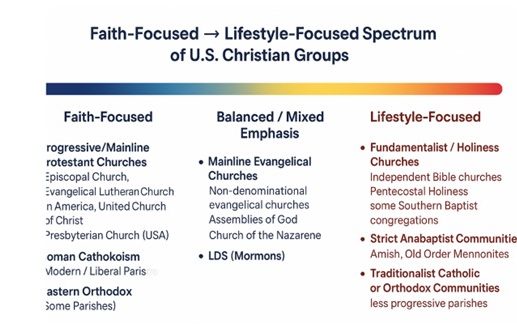
Faith-Focused → Lifestyle-Focused Spectrum of U.S. Christian Groups
Faith-Focused (Emphasize belief, grace, and inner transformation)
Progressive/Mainline Protestant Churches – Examples: Episcopal Church, Evangelical Lutheran Church in America, United Church of Christ, Presbyterian Church (USA).
Focus: Acceptance, social justice, faith in Christ as primary, lifestyle secondary.
Roman Catholicism (Modern / Liberal Parishes)
Focus: Faith, sacraments, love, and mercy; lifestyle rules emphasized less strictly in pastoral practice.
Eastern Orthodox (Some Parishes)
Focus: Spiritual formation, prayer, and community participation; less policing of personal lifestyle unless it affects sacramental participation.
Balanced / Mixed Emphasis (Faith matters, but lifestyle codes are enforced for leadership or discipline)
Mainline Evangelical Churches – Examples: Non-denominational evangelical churches, Assemblies of God, Church of the Nazarene.
Focus: Conversion is central, but behavior codes (sexual ethics, sobriety, modesty) affect leadership and sometimes membership.
LDS (Mormons)
Focus: Faith and conversion are critical, but strict lifestyle codes (sexual morality, substance abstinence, tithing, dress/grooming) are enforced.
Lifestyle-Focused (Behavioral conformity heavily emphasized)
Fundamentalist / Holiness Churches – Examples: Independent Bible churches, Pentecostal Holiness, some Southern Baptist congregations.
Focus: Moral and lifestyle adherence is tightly linked to membership and leadership eligibility; conversion alone is often not enough.
Strict Anabaptist Communities – Examples: Amish, Old Order Mennonites.
Focus: Community conformity, dress codes, and avoidance of “worldly” behaviors; deviation can lead to shunning.
Traditionalist Catholic or Orthodox Communities (less progressive parishes)
Focus: Lifestyle compliance (sexual morality, participation in sacraments) closely monitored; spiritual life judged through external behavior as well as belief.
Key Insight:
Faith-focused groups prioritize internal belief, mercy, and relational transformation; lifestyle rules exist mainly to support spiritual growth.
Lifestyle-focused groups see behavior and moral conformity as essential evidence of faith, often enforcing rules publicly.
Most churches fall somewhere in between, balancing conversion, faith, and behavioral expectations depending on theology, tradition, and cultural context.
American's are leaving Christianity behind:
One major factor is generational shifts. Younger generations, especially Millennials and Gen Z, are far less religious than Baby Boomers and Gen X. They grew up in a more diverse and digital world and don’t feel tied to institutions their parents embraced.
Another factor is the overlap of politics and religion. In the U.S., Christianity—particularly evangelical Christianity—has become strongly associated with partisan politics. Many who still believe in God or Jesus don’t want to be part of a movement they see as politically extreme or divisive.
LGBTQ+ and social justice issues also play a big role. Church stances on LGBTQ+ rights, gender equality, and women’s reproductive rights often feel out of touch with modern values of inclusion, equality, and compassion, especially to younger Americans.
Scandals and abuse have further damaged trust. Widespread reports of sexual abuse in the Catholic Church, financial scandals in megachurches, and leadership failures across denominations have left many disillusioned with religious institutions.
The rise of the “nones”—people who identify as religiously unaffiliated—shows another shift. Many still believe in God or some form of spirituality, but they reject formal church membership. “Spiritual but not religious” feels more authentic to them.
Science and education provide alternatives to traditional faith-based worldviews. For some, greater access to scientific explanations of life and the universe makes literal readings of scripture harder to accept.
Finally, individualism and choice are deeply ingrained in American culture. Many prefer to build their own spiritual path rather than follow institutions that feel rigid or outdated.