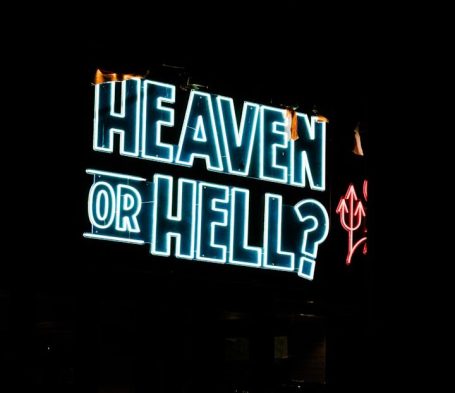
Do heaven & hell exist?
The concept came well before Christianity
As Christianity grew, different interpretations of heaven and hell emerged. A literal view developed, picturing them as real, physical places—heaven as the eternal home of the righteous, and hell as a place of eternal conscious torment.
Heaven & Hell
The Bible’s teachings on heaven and hell are more complex and nuanced than the simple “two-place” system many imagine today. In the Old Testament, the afterlife was centered on Sheol, a shadowy realm beneath the earth where all the dead went, righteous or wicked. It was not a place of torment or reward but a state of silence and separation from the living. During the Second Temple period, influenced by surrounding cultures, Jewish thought began to shift toward resurrection and judgment. The Book of Daniel, for example, speaks of the dead awakening, “some to everlasting life, others to shame and everlasting contempt.” Other Jewish writings, like 1 Enoch, describe vivid divisions of the afterlife, anticipating later Christian images of heaven and hell.
Jesus entered this landscape of debate and often spoke of the “Kingdom of Heaven” or “Kingdom of God,” which referred not only to a future hope but also to God’s reign breaking into the present. When He warned of hell, He used the word Gehenna, the name of a valley outside Jerusalem associated with fire and past idol sacrifices. Gehenna became a symbol of destruction and judgment, but Jesus’ emphasis was often more on choosing life with God than on painting a literal geography of the afterlife. The New Testament continues to develop these ideas. Paul speaks of resurrection as the central hope of believers, describing bodies raised imperishable at Christ’s return. Revelation envisions a final judgment in which death and evil are cast into the “lake of fire,” while the faithful live with God in a renewed heaven and earth where “there is no more death, mourning, crying, or pain.”
As Christianity grew, different interpretations of heaven and hell emerged. A literal view developed, picturing them as real, physical places—heaven as the eternal home of the righteous, and hell as a place of eternal conscious torment. This interpretation leaned on passages like John 14:2, Matthew 25:46, and Revelation 20:10. Others embraced annihilationism, understanding heaven as eternal life with God but interpreting hell as final destruction rather than ongoing torment, supported by verses like Matthew 10:28 and 2 Thessalonians 1:9. Still others, in a universalist view, treated hell as temporary separation or purification, pointing to verses such as 1 Timothy 2:4 and Colossians 1:20 that describe God’s desire to save all people and reconcile all things. Across these interpretations, heaven is consistently affirmed as real, though understood either as God’s dwelling place or a renewed creation, while hell varies in meaning from eternal punishment to annihilation to temporary discipline.
Later church tradition, especially in the writings of Augustine and through cultural works like Dante’s Inferno, solidified the image of heaven and hell as fixed eternal destinations for souls immediately after death. This was shaped not only by the Bible but also by Greek and Roman ideas of the immortal soul, as well as by Jewish apocalyptic writings that circulated during the time of Jesus. Over the centuries, these ideas came to dominate Western Christianity, even though the earliest biblical emphasis was more on resurrection, judgment, and renewal of creation than on static places of reward and punishment.
Christianity, however, is not the only tradition to grapple with these questions. In Mesopotamia, people believed in a shadowy underworld called the Land of No Return; in ancient Egypt, souls faced the “weighing of the heart,” where the righteous could enter paradise and the wicked faced annihilation. Greek and Roman myths described Hades, divided into regions like Elysium for the virtuous and Tartarus for the wicked, ideas that influenced both Judaism and Christianity. Judaism itself moved from a view of Sheol to a belief in resurrection and judgment, and Islam developed clear images of Jannah (paradise) and Jahannam (hellfire), with varying degrees of reward and punishment. In Eastern religions, Hinduism and Buddhism both describe multiple heavens and hells, usually temporary, shaped by karma and rebirth, while Taoist and Chinese folk traditions describe Diyu, an underworld where souls undergo trials before reincarnation. Norse mythology spoke of Valhalla for warriors and Hel for others, while Mesoamerican cultures like the Maya and Aztecs envisioned layered heavens and underworlds. Even Native American traditions often spoke of a “happy hunting ground” or spirit world for the virtuous and darker realms for the wicked.
Taken together, these traditions show that the concepts of heaven and hell—or at least paradise and punishment—are not unique to Christianity but part of a broader human story. Nearly every culture has sought to answer the same questions: Is there justice after death? and Is there hope beyond the grave? Christianity is distinctive in tying these questions to the story of resurrection, final judgment, and God’s promise to renew creation, but it echoes and overlaps with themes found across the ancient and modern world.