
Gender
The Bible contains a mix of perspectives on Gender—some reflecting ancient patriarchal norms, and others showing surprising moments of dignity, leadership, and value given to women.
Gender
The Bible contains a mix of perspectives on Gender—some reflecting ancient patriarchal norms, and others showing surprising moments of dignity, leadership, and value given to women.
1. In Creation Stories (Genesis 1–2)
Genesis 1:27 says: “God created mankind in his own image… male and female he created them.”
→ This suggests men and women both reflect God’s image equally.
In Genesis 2, Eve is made from Adam’s rib (side). Some traditions interpret this as equality (she’s not made from his head to rule over him, nor from his feet to be beneath him, but from his side to be beside him).
Others, however, have historically used this story to argue for male priority since Adam was created first.
2. In Ancient Israel’s Culture
Women often had fewer rights: inheritance went through men, leadership was usually male, and women were often under the authority of fathers or husbands.
Yet, there are standout women who led and commanded respect:
Deborah (Judges 4–5) – a judge and prophet who led Israel.
Esther – a queen who saved her people.
Ruth – praised for loyalty and faithfulness, with her story central to Israel’s lineage.
3. In Jesus’ Ministry
Jesus treated women in ways that broke cultural norms:
He taught women openly (Luke 10:38–42).
Women were the first witnesses of the resurrection (John 20, Luke 24).
He spoke with and honored marginalized women (like the Samaritan woman in John 4).
4. In the Early Church
Women like Phoebe (Romans 16:1), a deacon, and Junia (Romans 16:7), called “outstanding among the apostles,” show women in leadership roles.
Yet, some letters of Paul (like 1 Corinthians 14:34–35, 1 Timothy 2:11–12) suggest women should remain silent or not teach, reflecting the patriarchal culture of the time.
5. So, Equal or Better?
Not equal in practice: Social structures were overwhelmingly male-dominated.
Equal in theology: Both men and women are created in God’s image.
Sometimes better in example: Many stories highlight women’s faith, courage, and leadership in contrast to failing men (e.g., Deborah vs. cowardly Barak, or the faithful women at the cross vs. the fleeing disciples).
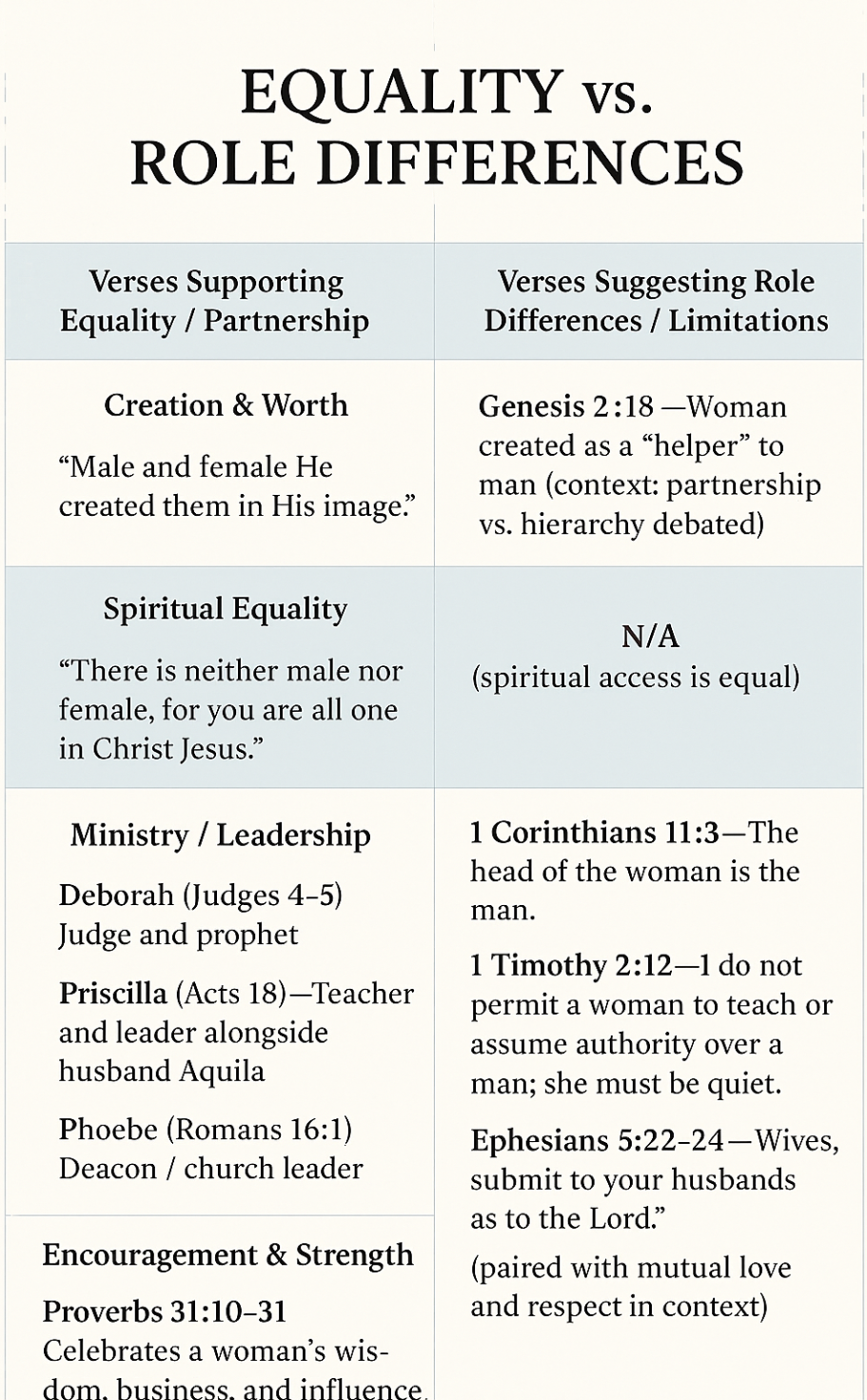
The Bible’s statements about gender equality are complex and often debated because they reflect both historical cultural norms and theological principles. It doesn’t provide a single, straightforward answer but instead contains passages that both affirm and limit roles for men and women. Here’s a structured overview:
1. Equality in Creation
Genesis 1:27 – “So God created mankind in his own image, in the image of God he created them; male and female he created them.”
This verse is foundational. Both men and women are made in God’s image, suggesting intrinsic value, dignity, and equality in worth.
Genesis 2:18 – “It is not good for the man to be alone. I will make a helper suitable for him.”
The word “helper” (ezer in Hebrew) does not imply inferiority; it’s often used to describe God Himself as a helper of humans. Contextually, this suggests partnership rather than subordination.
2. Equality in Spiritual Standing
Galatians 3:28 – “There is neither Jew nor Gentile, neither slave nor free, nor is there male and female, for you are all one in Christ Jesus.”
This is one of the clearest statements of spiritual equality in the New Testament. All believers share equal access to God regardless of gender.
Acts 2:17-18 – During Pentecost, Peter quotes Joel: “Your sons and daughters will prophesy… Even on my servants, both men and women, I will pour out my Spirit.”
Both genders are empowered to serve God’s mission and ministry.
3. Roles and Limitations
Some passages reflect the cultural norms of their times and suggest specific roles for men and women:
1 Corinthians 11:3 – “The head of every man is Christ, and the head of the woman is man.”
1 Timothy 2:12 – “I do not permit a woman to teach or to assume authority over a man; she must be quiet.”
These verses are often interpreted in light of the cultural context of the early church. Scholars debate whether they are prescriptive for all time or situational guidance.
4. Examples of Women in Leadership
Deborah – A judge and prophet in Israel (Judges 4–5), showing women can hold leadership and authority.
Priscilla – A teacher and leader in the early church (Acts 18), instructing both men and women.
Phoebe – A deacon (Romans 16:1), entrusted with leadership responsibilities.
5. Summary
The Bible affirms equal worth and dignity of men and women.
Spiritually, men and women have equal access to God and ministry.
Some passages suggest different roles, often influenced by historical and cultural contexts.
Biblical examples show women leading, teaching, and prophesying, highlighting that leadership is not strictly gender-bound.